Insights
NY Commercial Litigation Report
March 2026 | Volume 18




First Department: Owners of Bahamas Four Seasons Resort failed to show that relevant factors strongly favored forum non conveniens dismissal.
Koval v. Access Industries, 246 N.Y.S.3d 77 (1st Dep’t 2026).
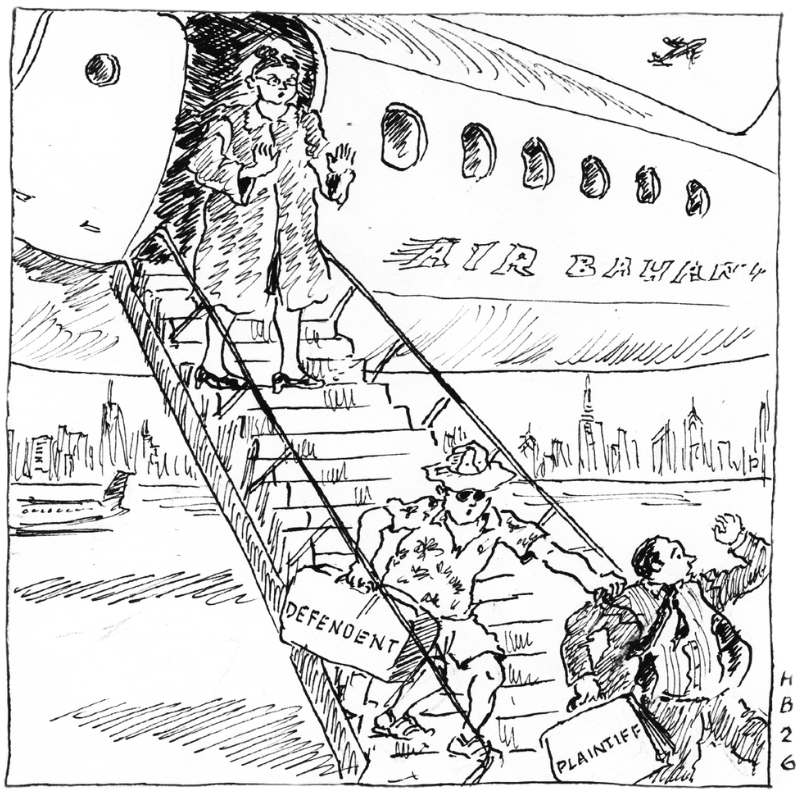
The doctrine of forum non conveniens or “FNC,” codified in CPLR 327, empowers courts to dismiss an action where, “in the interest of substantial justice,” the case should be heard in another forum. New York courts consider five FNC factors, none of which is dispositive: (i) the burden on the local courts; (ii) the potential hardship to the defendant; (iii) the (un)availability of an alternative forum; (iv) the parties’ residence; and (v) whether the transaction from which the plaintiff’s cause of action arises primarily occurred abroad. Defendants bear a “heavy burden” to establish that the balance of these factors “strongly” favors FNC dismissal.
The plaintiff, a Pennsylvania resident, was injured in a slip-and-fall accident in the steam room of a Four Seasons resort in the Bahamas. She later commenced a personal injury action in New York, alleging that flooring material installed during a recent renovation was inappropriate for use in a steam room and created an unreasonable risk of injury. The defendants moved for FNC dismissal, emphasizing that the accident giving rise to plaintiff’s injuries occurred in the Bahamas, most witnesses and other evidence were located there, and Bahamian law applied. But the trial court denied the motion, finding that the plaintiff’s hardship in having to litigate her claims in the Bahamas outweighed the not “particularly onerous” burden the New York forum imposed on the defendants.
The First Department affirmed. It found Bahamian law was not “distinctly abstruse,” such that its application would not impose an undue burden on the New York courts. On the other hand, the court ruled, the plaintiff would suffer hardship if forced to litigate in the Bahamas, whose legal system does not allow for jury trials or pretrial depositions. The court also found “a substantial nexus to New York” because “the majority of the evidence regarding the design, installation, and construction of the steam room where plaintiff’s accident occurred” was located in New York and plaintiff’s daughter, “the only eyewitness to the accident,” was a New York resident. In the end, the court explained, “[t]he burdens defendants may face litigating in New York” were simply “part of the price which may properly be demanded of those who extensively engage in international trade.”
Read the court’s full decision here.
Second Circuit: Afghan central bank’s blocked assets remained immune from attachment and execution following the Taliban’s overthrow of Afghanistan’s government.
Havlish v. Taliban, 152 F.4th 339 (2d Cir. 2025).
The Foreign Sovereign Immunities Act (“FSIA”) immunizes the property of a foreign state, and of its agencies and instrumentalities, in the United States from attachment or execution unless one of the exceptions enumerated in the statute applies. The Second Circuit held that FSIA immunity extends to any state whose statehood the Executive Branch recognizes, regardless of whether the United States recognizes its current government, and that a foreign central bank’s operational independence does not impact its status as an agency or instrumentality of its parent state.
On August 15, 2021, as the Taliban seized control of Kabul, the U.S. Treasury Department blocked approximately $7 billion in assets held by Da Afghanistan Bank (“DAB”), Afghanistan’s central bank, at the Federal Reserve Bank of New York. Two groups of terrorism victims sought to attach or seize those blocked funds in aid of their existing or potential future judgments against the Taliban. But the district court denied their motions to attach or seize the assets.
The Second Circuit affirmed. On appeal, plaintiffs first argued that Afghanistan no longer qualified as a “foreign state” following the Taliban’s takeover. But the court disagreed. Relying on the United States Supreme Court’s decision in Zivotofsky ex rel. Zivotofsky v. Kerry, 576 U.S. 1 (2015), which deemed the Executive Branch’s formal recognition of a state dispositive, the Second Circuit found the question was “not close” because the “Executive Branch continues to afford formal recognition to the state of Afghanistan, even as it denies formal recognition of any government thereof.”
Plaintiffs next argued that, in any event, DAB did not qualify as an “agency or instrumentality” of Afghanistan because it was “entirely independent” under Afghan law. But the court rejected that argument as well. Under the FSIA, an entity is an agency or instrumentality of a foreign state if it: (i) is a “separate legal person”; (ii) is an “organ” of, or majority-owned by, the foreign state; and (iii) is neither a citizen of the United States nor created under the laws of any third country. Applying these factors, the Second Circuit noted that it has “consistently recognized that central banks qualify as agencies or instrumentalities of foreign states”. While Afghan banking law vests DAB with substantial operational autonomy, the court explained, the same law provides that DAB is wholly owned by the state of Afghanistan (thereby satisfying the statutory test’s second factor).
The court also rejected plaintiffs’ attempt to rely on the Terrorism Risk Insurance Act (“TRIA”) to abrogate the immunity of DAB’s assets from attachment and execution. The court reasoned that DAB was not (yet) an agency or instrumentality of the Taliban on the date when DAB’s assets were blocked on August 15, 2021, the day “Kabul fell to the Taliban.”
Read the court’s full decision here.
Second Circuit: Hague Service Convention permits only use of affirmatively authorized service methods and thus does not permit email service.
Smart Study Co., Ltd. v. Shenzhenshixindajixieyouxiangongsi, 164 F.4th 164 (2d Cir. 2025).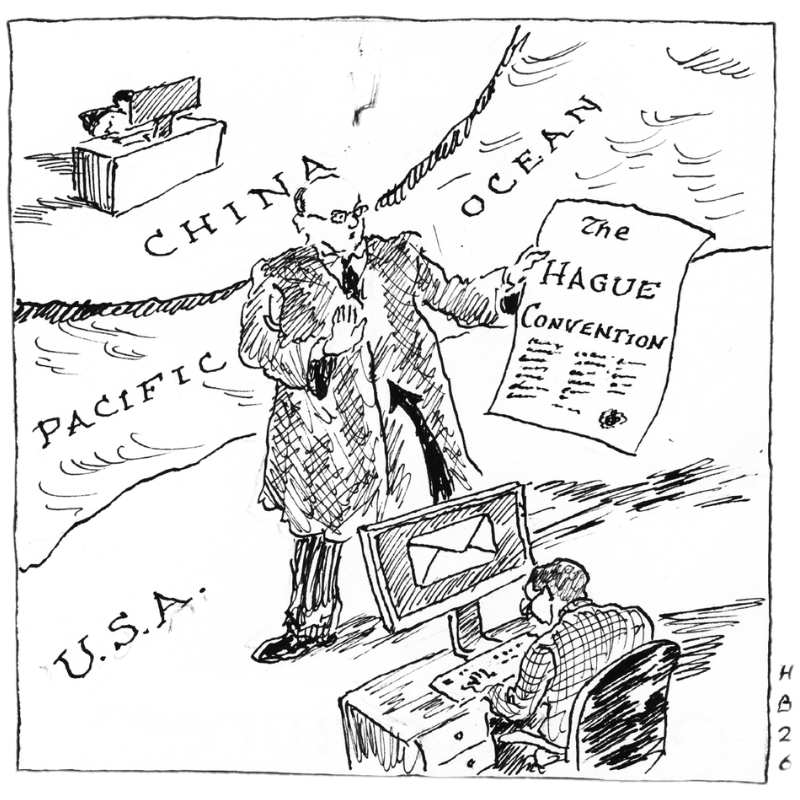
Where a plaintiff seeks to serve a defendant in a country that is a party to the Hague Service Convention, the Convention supplies the exclusive framework for service of process in that country, and failure to comply with the Convention’s requirements may deprive the court of personal jurisdiction. But the Convention, which dates back to 1965, makes no mention of service by email, and lower courts have divided on how to address this gap. The Second Circuit held, as a matter of first impression, that the Convention creates a “closed universe” of permissible service methods, which do not include email.
Smart Study, a global entertainment company and owner of trademarks associated with the “Baby Shark” children’s song, brought a trademark infringement action in the Southern District of New York against dozens of Chinese-based defendants and applied ex parte for permission to serve them by email. After the district court authorized service on that basis, only two defendants appeared. But the appearing defendants argued that the court lacked personal jurisdiction over them because the Convention prohibits email service on Chinese parties. Before the district court could rule on that challenge, Smart Study voluntarily dismissed the two defendants. When the remaining defendants failed to appear, Smart Study moved for a default judgment. This time, however, the district court appointed a disinterested legal advisor to opine on whether the Convention permitted email service on the Chinese defendants. The court ultimately concluded that it did not and accordingly denied the motion for a default judgment.
The Second Circuit affirmed. It held that modes of service not specified in the Convention—including email—are preempted wherever the Convention applies. As the court explained, “reading into the Convention’s silence implicit permission for all types of service not affirmatively barred would render meaningless its ‘approved methods of service,’ encouraging end-runs around the very system it created.” The Convention, the court emphasized, “was not designed to ensure that the service of process in China is as efficient and fast as domestic service in the United States.”
The court also rejected Smart Study’s argument that the Federal Rules of Civil Procedure permit service “by other means” in exigent circumstances where attempts at Hague service were likely to be futile. The Second Circuit appeared skeptical of this argument, noting that the relevant provision, Rule 4(f)(3), “states only that a party may serve a defendant ‘by … means not prohibited by international agreement’; it makes no mention of urgency or exigent circumstances.” But, in any event, the court held, Smart Study had “not demonstrated any exigent circumstances,” as its own local counsel in Beijing had concluded that the defendants’ known physical addresses might be accurate.
Stay informed of Chaffetz Lindsey’s updates, new articles, and events invitations by subscribing to our mailing list.


Chaffetz Lindsey LLP
1700 Broadway, 33rd Floor
New York, NY 10019
tel: +1 212 257 6960
fax: +1 212 257 6950
©2025 Chaffetz Lindsey LLP
Attorney Advertising. Prior results do not guarantee a similar outcome.